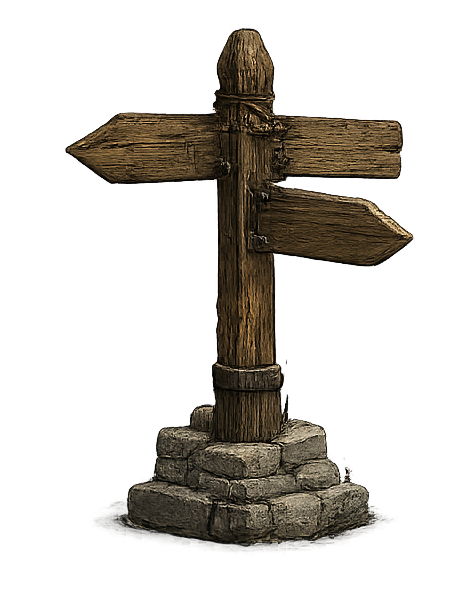
There are many roads in Albion.
Some are marked on maps. Some are remembered by old scouts who swear they know a shortcut, then somehow arrive three zones away with a story, a limp, and no apology.
Some roads run through Camelot, proud and bright, where fresh-faced adventurers once stepped into the world believing armour made them safe and directions made sense.
Some roads run north, into the teeth of Midgard, where the snow is bitter, the axes are large, and the locals communicate mostly through shouting and blunt force.
Some roads run west, toward Hibernia, where the trees whisper, the mist moves strangely, and everything small enough to punt is probably about to ruin your evening.
But there is one road that does not appear on any map.
It is the road back.
Back through time. Back through screenshots. Back through half-remembered voices on voice comms. Back through old jokes, bad pulls, impossible escapes, and the sacred guild tradition of blaming lag when the truth was clearly stupidity.
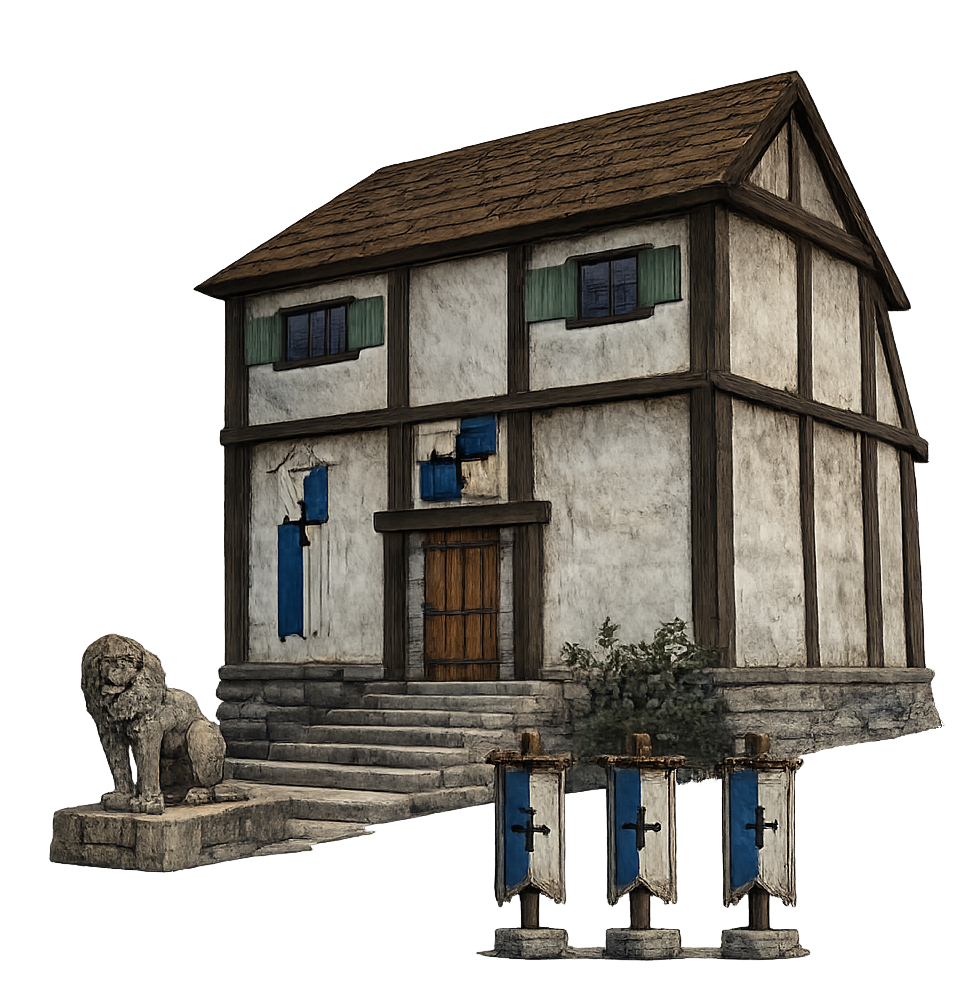
That road leads to the Tavern of Prime Evil.
You will know it when you find it.
The sign hangs crooked above the door, because no one ever fixed it properly and by the third attempt everyone had agreed it was “character.” The banner outside has seen better years, worse weather, and at least one argument about whether the colours were the right way round.
Inside, the fire is always lit.
No one knows who lights it.
Some say Gudd does, though no one has ever seen him do anything as delicate as lighting a fire. Others say Berthold struck the first spark with a stolen Hibernian dagger while running away from consequences. A scout once claimed he lit it from stealth, which was impressive right up until someone pointed out he had been in the tavern all night.
The truth is simpler.
The fire burns because someone remembers.
That is how old guilds work.
Not through rosters. Not through raid calendars. Not through shiny recruitment banners or perfectly organised ranks with names like “High Executive Assistant Deputy Warlord of Attendance.”
A guild like Prime Evil lives because someone logs on after years away and says, “Anyone still about?”
And somewhere, in the rafters of memory, the whole tavern answers.
At the first table sits Gudd.
Armsman of Albion. Plate-wrapped certainty. A man so solid that keep doors felt safer when he was nearby. He does not say much, which is wise, because if Gudd ever wasted words the realm might suffer structural damage.
He is the sort of man who stands at a gate and makes the gate feel redundant.
You do not ask Gudd whether the line will hold.
If Gudd is there, the line is holding.
Beside the fire, never quite sitting still, is Berthold.
Minstrel. Guildmaster. Speed-song rogue. Professional finder of trouble. He carries a lute, a blade, and the deeply suspicious expression of a man who has already left the group, climbed a wall, charmed something with teeth, and returned with news that begins, “Right, don’t panic.”
Everyone panics.
Berthold does not merely play music.
He moves people.
He moved the slow. He moved the lost. He moved whole groups into situations they later described as “nearly controlled.” He gave Prime Evil rhythm, speed, and just enough confidence to turn bad ideas into traditions.
Above the bar hangs a small sign:
NO STEALTHERS BEHIND THE COUNTER.
No one obeys it.
Collegian is probably there now.
No one has seen him come in. No one has seen him leave. His chair is empty, his cup is full, and a plate of sammiches has moved three inches closer to the shadows.
That is how you know he is present.
Scouts are not absent. They are pending.
Collegian speaks rarely, usually at the exact moment everyone realises they should have listened earlier. His warnings are short, dry, and not always immediately useful.
“Sammiches,” he might say.
And four seconds later, half the tavern is mezzed.
This is not a failure of communication. This is scout poetry.
Near the back, someone is counting.
That will be Osana.
A Welshman with humour black enough to make a necromancer uncomfortable, Osana never saw a keep defence he could not improve with a filthy joke and terrible timing. He had the gift of saying the wrong thing at precisely the right moment, which is one of the highest arts known to tavern warfare.
When the siege engines rolled up and the walls began to shake, others would call for oil, arrows, shields and heals.
Osana would count them in.
One, two, three, four.
Boots upon the floor.
Five, six, seven, eight.
Someone kiss the gate.
Nine, ten, here they come.
Bang upon the drum.
And there it was.
The Come Drum.
A phrase so cursed, so stupid, so perfectly Prime Evil, that once heard it could never be removed from the guild’s collective skull. It was not strategy. It was not doctrine. It was not even English behaving responsibly.
But when Osana shouted it, people laughed.
And when people laughed, they stopped being afraid.
That counts as leadership in Albion.
Somewhere nearby is Mib the Paladin.
You can tell because the room feels slightly more cheerful and someone has made a joke about arms. By day, so the tale goes, he dealt in weapons. By night, he wore Albion plate and joined the runs with the sort of grin that made even bad pulls feel worth doing.
A Paladin is meant to bring chants, courage and steadiness.
Mib brought all three, plus the immortal phrase:
“Look at my gunz.”
No scholar has yet agreed whether he meant weapons, muscles, inventory, or all of the above. The tavern refuses to clarify. Mystery improves the flavour.
And then there is Hawkslayer.
Armsman. Welsh grit. Still there. Still turning up. Less chatty than the rest, which, in this guild, may be considered a medical miracle.
Some players become legends through a single great deed.
Hawkslayer took the harder route.
He logged on.
Again.
And again.
And again.
For years.
That may not sound glamorous to people who only understand stories with dragons in them, but old guilds know better. The one who keeps showing up is the one who keeps the banner from becoming decoration.
You log on, and there he is.
Defending the line.
Not making a grand speech. Not asking for applause. Not composing a twelve-part emotional memoir about the burden of duty.
Just there.
Getting on with it.
Probably asking, “Which button is it?”
And somehow pressing the right one often enough that Albion remains everyone else’s problem.
That is the Tavern of Prime Evil.
A place where the names are not neat.
They are noisy.
They are Gudd, Berthold, Collegian, Mib, Osana, Hawkslayer, Solitare, Ringpull, Oljad, Ninja, Firebirth, Yaroth, and all the others whose echoes still clatter around the room like loose tankards.
Some have gone dark.
Some are online.
Some are half-remembered by a quote, a class, a screenshot, or one stupid thing they said twenty years ago that turned out to be immortal.
That is enough.
A guild history is not a museum.
It is not a list of dates.
It is not the dry record of who dinged what, when, and with which template.
A real guild history is a tavern argument that never ended.
It is someone insisting the wipe was not their fault.
It is someone else remembering exactly why it was.
It is a cleric who kept everyone alive and somehow received the blame anyway.
It is a scout saying “inc” after the evidence has become overwhelming.
It is a minstrel shouting speed while the group runs directly toward disaster.
It is an Armsman standing at the gate because someone has to.
It is a Paladin glowing nobly for six seconds before chaos resumes.
It is Welsh counting, crude jokes, dry warnings, bad pulls, good runs, and laughter that survived longer than half the keeps.
Outside the tavern, the old world waits.
Camelot still dreams.
Midgard still sharpens axes and shouts at weather.
Hibernia still slips through mist pretending murder is cultural.
Hurbury still stands in the memory, its stones warm from every defence, every wipe, every late-night run and every ridiculous claim that “we nearly had them.”
And Prime Evil?
Prime Evil is still here.
Not because the servers stayed the same.
Not because everyone stayed young.
Not because the old frontier remained untouched by time.
Prime Evil is still here because people came back to the fire.
Because someone rebuilt the hall.
Because someone remembered the names.
Because someone turned old jokes into songs.
Because someone looked at twenty years of nonsense, friendship, bravery and glorious failure and said:
“This deserves a place.”
So welcome to the tavern.
Pull up a chair.
Raise a cup.
Tell the story badly first. That is tradition.
We will polish it later, probably make it worse, add drums, blame lag, and sing it until the roof complains.
For Albion.
For Hurbury.
For the old names.
For the ones gone dark.
For the ones still online.
For every fool who wore the banner.
The fire is lit.
The horn is on the wall.
The Come Drum is, regrettably, still available.
And somewhere beyond the door, the frontier is calling again.
Prime Evil rides.